
Traditionally, most PSUs have been cash-rich, which added to their value. However, the government has been tapping regularly into their cash resources to boost revenue for the exchequer

PowerGrid was the top gainer in the Sensex pack, rallying over 6 per cent, followed by Tech Mahindra, HCL Tech, Titan, L&T, NTPC and ICICI Bank.

The divestment process, however, will not be an easy affair as there are multiple stakeholders, including the employee unions, whose concerns will have to be addressed.

What the RBI should ensure is that its rules are appropriately framed and uniformly implemented with transparency, fairness and correctness

The agency said that over the next two years new NPL formation rates would witness a gradual decline.
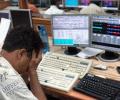
ITC was the top loser in the Sensex pack, tumbling over 5 per cent, followed by ICICI Bank, Kotak Bank, Axis Bank, SBI and HDFC Bank. NSE Nifty sinks 354 points to 17,857.25.

It is imperative to check the basics of a company before investing in it

He advised banks to facilitate appropriate credit expansion.

The government is set to initiate consultations with the Reserve Bank of India (RBI) to devise a new security clearance framework for screening potential bidders of public sector banks (PSBs) as it kick-starts the privatisation process, beginning with the strategic divestment of IDBI Bank. As the government is moving ahead with strategic divestment of IDBI Bank and is looking to privatise two PSBs, the Department of Investment and Public Asset Management (DIPAM) is looking to put in place an appropriate framework as the potential buyers will have to meet the RBI's fit and proper criteria, said an official. The process of bank privatisation would be different from the sale of any other public sector undertaking (PSU), and more restrictions and measures will have to be put in place, the official said.

In the year to date, 61 PSUs have lost an average of 22 per cent, with five companies losing more than half their share value. The BSE PSU index is down 10.6 per cent.

IndusInd Bank was the top gainer in the Sensex pack, jumping nearly 5 per cent, followed by Bharti Airtel, HCL Tech, Reliance Industries, Titan and Asian Paints.

The BSE Sensex slumped 456 points on Wednesday, tracking losses in index majors Reliance Industries, Infosys and ICICI Bank as market participants continued to book profits at high levels.
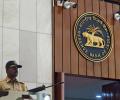
Move can also bring a huge change in the way business is done in India, where firms use multiple current accounts, often for even individual projects, making them difficult to monitor.
The performance has been a clear contrast to the movement in the first two months of 2014, when the S&P BSE PSU index massively underperformed the S&P BSE Sensex (down 0.2 per cent) by slipping nearly seven per cent.
Finance Minister P Chidambaram on Friday said he has asked PSU banks to provide loans at lower interest rates to workmen, like cobblers and washermen, and brushed aside apprehensions of possible repayment delays by them. Chidambaram said he had directed that all branches of PSU banks, numbering over 70,000, should provide Rs 5,000 loans at four per cent interest to workmen. He also wanted shepherds and fishermen to be added to the list of workers who could be given the loans.

Fund managers are withdrawing after a two-year long run in public sector bank (PSB) stocks. Domestic mutual funds (MFs) were net sellers of PSB stocks for the first time in nine quarters, offloading shares worth Rs 1,800 crore in the March quarter, said a report by ICICI Securities. In the previous eight quarters, fund houses had invested more than Rs 10,000 in PSBs amid deep discounts in valuation vis--vis their private sector peers.

Recovering from an order dry-up and change in market conditions, Gurgaon-based Rites is looking to bid aggressively in global export and consultancy tenders and run with a volume-led approach, its chairman and managing director (CMD) Rahul Mithal said. Rites is a railway consultancy public sector undertaking (PSU) under the aegis of the Ministry of Railways. "We started the year with two huge challenges - the export order book, where no new orders had happened, and the opening up of Indian Railways quality assurance works to four players.
Reserve Bank of India Governor Raghuram Rajan had said recently that there was "no need" to set up a separate bad bank to deal with stressed assets of public sector lenders.

HDFC was the top loser in the Sensex pack, shedding nearly 2 per cent, followed by Kotak Bank, Asian Paints, UltraTech Cement, HDFC Bank, HUL and Tech Mahindra.

From the Sensex pack, State Bank of India, ICICI Bank, IndusInd Bank, Axis Bank, Kotak Mahindra Bank, HDFC Bank, Reliance Industries were among the major laggards. Bucking the trend, auto stocks Tata Motors and Mahindra & Mahindra closed with gains.

Tata Steel was the top loser in the Sensex pack, plunging over 8 per cent, followed by SBI, Dr Reddy's, Kotak Bank, Sun Pharma, Bajaj Auto and L&T. NSE Nifty declined 118.35 points or 0.71 per cent to 16,450.50.

These firms offer job security and lucrative salries.
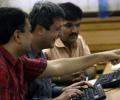
Major gainers in the Sensex pack were Wipro, Kotak Bank, Infosys, Maruti, Tata Motors, L&T, IndusInd Bank, Hero MotoCorp, M&M, SBI, ONGC, HDFC Bank and HUL, rising up to 3 per cent.
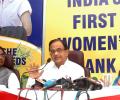
Welcoming the launch of the Bharatiya Mahila Bank, India Inc on Wednesday said the initiative will propel women's financial inclusion, encourage female entrepreneurs and empower women in the country.

Despite unprecedented levels of uncertainty in Samvat 2077, investors have little to complain about on the returns front. The BSE Sensex delivered returns of 38 per cent in this period, while the Nifty registered a return of over 40 per cent. As is the case in bull markets, companies in the small- and mid-capitalisation basket outperformed the benchmarks, with returns almost twice those of frontliners.

Banking services across the country were hit on Wednesday by the day-long strike by 10 central trade unions and 14 bank unions, but workers of largest lender SBI and a few other banks stayed off the agitation.
'The financial sector will be hit even harder than the overall market.' 'The banking sector will eventually be rescued.' 'But it may go into a long downwards spiral before things turn around.' 'Threat or buying opportunity?' asks Devangshu Datta.

IndusInd Bank was the top loser in the Sensex pack, shedding over 3 per cent, followed by HUL, ONGC, ICICI Bank, Axis Bank, Kotak Bank, M&M and Tech Mahindra. NSE Nifty tumbled 154.25 points to 14,696.50.
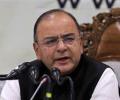
He said the Finance Minister assured the delegation that the Financial Services Secretary would look into the matter and the settlement process would be expedited.

RBI may revise remuneration for banks.

Titan was the top gainer in the Sensex pack, rallying over 5 per cent, followed by Bajaj Auto, Bajaj Finserv, SBI, Nestle India, ITC, Axis Bank and Tata Steel. Nifty rose 46 points to its fresh closing peak of 17,991.95.
PowerGrid was the top gainer in the Sensex pack, rising around 4 per cent, followed by NTPC, Tata Steel, Bharti Airtel, Sun Pharma and Bajaj Finserv. On the other hand, IndusInd Bank, Asian Paints, Infosys, Bajaj Auto and Maruti fell up to 2.59 per cent.
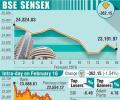
The S&P BSE Sensex ended down 362 points at 23,191.

Equity benchmark Sensex climbed 154 points to end at a fresh all-time high on Monday, tracking gains in ICICI Bank, L&T and Kotak Bank amid persistent foreign fund inflows and a largely positive trend in global markets.
ITC was the top loser in the Sensex pack, shedding nearly 3 per cent, followed by Tech Mahindra, Axis Bank, Asian Paints, TCS, HCL Tech, HDFC and Kotak Bank.
NPA problem to continue for next 2-3 quarters: banks to FinMin

India's economy will do well once vaccination reaches a critical mass as pent up demand, global recovery and easy financial conditions will boost activities, RBI's Monetary Policy Committee (MPC) member Ashima Goyal said on Tuesday.
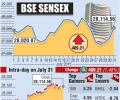

Sectorally, telecom, realty, auto and banks were among the top losers, shedding as much as 2.22 per cent.
